Add two testcases to TEST-71-HOSTNAME:

 - testcase_tags exercises the new "hostnamectl tags" +/- prefix syntax
   (add/remove, idempotency, the no-mixing rule, invalid input), the
   AddAndRemoveTags() D-Bus method and the SetTags() Varlink method
   (set/add/remove, explicit empty set, current-list basis).

 - testcase_varlink_setters exercises the new SetHostname(),
   SetStaticHostname(), SetPrettyHostname(), SetIconName(), SetChassis(),
   SetDeployment() and SetLocation() Varlink methods, including resetting
   values via null and rejection of invalid input.
When a device carries a SYSTEMD_MACHINE_TAG udev property, tag it for
systemd and pull in systemd-machine-tag@<tag>.service, which adds the
given tag to the host's machine tags. In other words, attaching the
property to a device makes the host auto-tag itself with the specified
machine tag.
Add a service template that adds the machine tag given as its instance
name to the host's machine tags. Whenever an instance is pulled in, the
tag is added; the operation is idempotent.

It talks to hostnamed over Varlink (which is socket-activated), so it
works very early at boot, before the system bus is up. It is ordered
after local-fs.target so that /etc/machine-info can be written, requires
hostnamed's socket and the local filesystems to be available, and does
not run in the initrd.
Teach the "tags" verb to accept arguments prefixed with '+' or '-': a
'+'-prefixed argument adds all of its (colon-separated) tags to the
configured list, a '-'-prefixed one removes them, mapping onto the new
AddAndRemoveTags() D-Bus method. The prefix applies to the whole
argument, so e.g.

    hostnamectl tags +foo:bar -quux:ooo

adds foo and bar and removes quux and ooo. Plain (replace) and prefixed
(add/remove) arguments may not be mixed in one invocation.
Let's refactor things so that there's a separate xyz_is_valid() call for
each field, and make it mostly wrap string_is_safe().

This tightens the rules on some fields, mostly to refuse newlines and
some other things.
Wire up the usual SIGRTMIN+18 control signal handler and a memory
pressure event source in hostnamed's event loop, like our other
long-running daemons, so it reacts to memory pressure (e.g. by trimming
its heap) and supports the common debug/control commands. Watchdog
support via sd_event_set_watchdog() was already in place.
Add a SD_VARLINK_FIELD_COMMENT for every field of the Describe() method
that still lacked one, plus an interface comment and a symbol comment for
the Describe() method itself, so that introspecting io.systemd.Hostname
produces fully documented output.
Add SetHostname(), SetStaticHostname(), SetPrettyHostname(), SetIconName(),
SetChassis(), SetDeployment() and SetLocation() to the io.systemd.Hostname
Varlink interface, mirroring the existing D-Bus methods of the same names.

Each takes a single nullable string "newValue" (null clears/resets the
value; the method name itself makes clear what the value is) plus the usual
allowInteractiveAuthentication polkit input, and applies the same
validation, polkit actions and /etc/hostname resp. /etc/machine-info
persistence as its D-Bus counterpart. The five machine-info setters share
a common helper. The hostname validator is reused from the D-Bus path,
translating its INVALID_ARGS error into a Varlink invalid-parameter error.

Being reachable over the socket-activated Varlink socket, these work in
early boot before the system bus is up.
Add a SetTags() method to the io.systemd.Hostname Varlink interface that
combines what the D-Bus SetTags() and AddAndRemoveTags() methods do into
a single call: it takes three tag lists, 'set', 'add' and 'remove'. If
'set' is supplied the tag list is first reset to it (an explicit empty
array clears it), otherwise the current tags are used as basis; then the
'add' tags are added and the 'remove' tags are dropped.

The set arithmetic is shared with the D-Bus AddAndRemoveTags() handler
via machine_tags_add_remove().

Being reachable over Varlink (and hence socket-activatable without the
system bus) this is usable very early at boot, before dbus-daemon is up.
Add a new D-Bus method on org.freedesktop.hostname1 that incrementally
updates the machine tags instead of replacing the whole list: it takes
two string arrays, one of tags to add and one of tags to remove, and
stores (current ∪ add) \ remove.

This avoids the read-modify-write race that clients would otherwise hit
when several of them each manage a subset of the host's tags.

Factor the tag persistence and the write-error-to-D-Bus-error mapping out
of method_set_tags() into helpers, and add a machine_tags_add_remove()
helper for the set arithmetic, all to be shared with further callers.
This is preparation for adding Varlink calls for these operations, as it
makes sense to unify log msg generation in one place (i.e. the callee)
rather than in two (the two callers, i.e. the D-Bus and the Varlink
interfaces).
Map the Power Boost key (top-right corner, scancode 0x64) to KEY_PROG1.
Map the Touchpad Toggle key (Fn+F8, scancode 0x76) to KEY_F21.

Verified working via evtest:

Event: type 4 (EV_MSC), code 4 (MSC_SCAN), value 64
Event: type 1 (EV_KEY), code 148 (KEY_PROG1), value 1

Event: type 4 (EV_MSC), code 4 (MSC_SCAN), value 76
Event: type 1 (EV_KEY), code 206 (KEY_F21), value 1

DMI: svnInfinix:*pnY3Max:*
AT keyboard scancodes: 0x64, 0x76 (set 2)
- This synchronize the state for existing stuff.
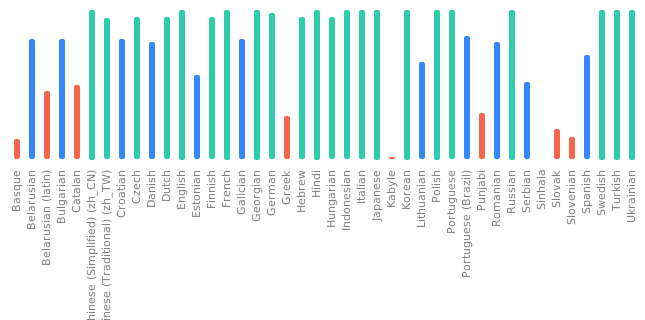
- Enable translations for Plymouth interaction strings.
- Translate them in French as an example.
Fixes#42384.
This changes some lines and add translations related to resolved
policies and sysupdate policies.

Signed-off-by: Raito Bezarius <masterancpp@gmail.com>
When the accumulated trie key exceeds the fixed-size line buffer,
linebuf_get() returns NULL. trie_fnmatch_f() passed that NULL straight
into fnmatch() as the pattern, causing a SIGSEGV on a crafted hwdb.bin
(reachable now that recursion is capped rather than overflowing the
stack first). Treat the NULL like the other corruption checks and
return -EBADMSG.

Follow-up for 73fea38cf1

Fixes https://github.com/systemd/systemd/issues/42376

Co-developed-by: Claude Opus 4.8 <noreply@anthropic.com>
When ssh-ing into a VM, you generally do not want to log
in as your user from the host. Let's default to the root
user unless a user is explicitly specified.
sshd reads AuthorizedKeysFile after dropping to the authenticating user's UID, so the
0400 credential file under %d/ is unreadable for non-root users. Materialize a 0444
copy in a RuntimeDirectory so the ephemeral key works for any user. */
Otherwise, it introduces cyclic dependencies:
```
systemd[1]: sockets.target: Found ordering cycle:
systemd-networkd-resolve-hook.socket/start after network-pre.target/start after
iptables.service/start after basic.target/start after sockets.target/start -
after systemd-networkd-resolve-hook.socket
systemd[1]: sockets.target: Job systemd-networkd-resolve-hook.socket/start deleted
to break ordering cycle starting with sockets.target/start
```
Follow-up for 37adb410a2.
Fixes#42353.
A hostile but structurally valid 382-byte PE32+ "EFI application" with a
single section whose VirtualSize is ~4 GiB and SizeOfRawData is 0 drives
uki_hash() into ~4.17 M iterations of SHA-256 over 1024 bytes of zeros
— wedging the parser for >10 s. Nine more slow-units share the same
shape. A separate MSAN finding from the new fuzzer (CIFuzz, memory
sanitizer) shows pe_load_headers() reading uninitialised heap memory
when SizeOfOptionalHeader is too small to actually contain
NumberOfRvaAndSizes.
Three tightenings in src/shared/pe-binary.c:
1. In pe_load_sections, reject sections whose PointerToRawData +
SizeOfRawData exceeds the actual file size. Raw section data must
fit inside the file; this is the parser-wide invariant
pe_hash / uki_hash / pe_read_section_data rely on.
2. In uki_hash, cap the (VirtualSize - SizeOfRawData) zero-padding
hash loop at 64 MiB. Real UKIs do not pad sections with tens of
MiB of zero-equivalent data; anything above this cap is a
malformed PE.
3. In pe_load_headers, reject a PE whose SizeOfOptionalHeader is too
small to cover up to NumberOfRvaAndSizes. Without this guard the
subsequent size-mismatch check reads uninitialised optional-header
bytes, caught by MSAN under CIFuzz.
Add the 382 B canonical reproducer (plus two structural siblings) and
the MSAN reproducer to test/fuzz/fuzz-pe-binary/. Also add a libFuzzer
harness in src/fuzz/fuzz-pe-binary.c and unit tests in
src/test/test-pe-binary.c that exercise each fix branch in isolation.
The 64 MiB hash boundary test is gated behind SYSTEMD_SLOW_TESTS so it
doesn't slow down emulated-arch CI.
This is a robustness fix, not a security fix: PE binaries consumed by
bootctl / systemd-stub / pcrlock / kernel-install / systemd-measure are
already trusted and signed at the consumer side, so the worst pre-fix
behaviour is wasted CPU on a UKI install / measure / inspect call.
Closes#42344.
Reported-by: AI-assisted libFuzzer campaign
Co-developed-by: Claude Opus 4.7 <noreply@anthropic.com>
We currently log at warning level:
/usr/lib/systemd/system/systemd-udevd.service:56: System call bpf cannot be
  resolved as libseccomp is not available, ignoring: Operation not supported

In the initrd, or in minimal installations, not installing libseccomp is
reasonable, depending on various other choices. We shouldn't make fuss
about this.

C.f. https://bugzilla.redhat.com/show_bug.cgi?id=2463540.
This was requested in https://github.com/systemd/systemd/issues/42333.
Indeed, this integration is using three levels of systemd magick, so
doing this correctly is not obvious. Let's include specific instructions
to help people for whom this integration is causing problems.
Many *at()-style helpers accept a directory fd that may be either a
regular, valid fd (>= 0) or one of the special AT_FDCWD/XAT_FDROOT
wildcard values, and open-code that check in their assertions. Add a
wildcard_fd_is_valid() helper for it and use it tree-wide.
When both --private-users and --network-namespace-path are
specified, systemd-nspawn fails to start with "Operation not
permitted" during the setns() call.

This occurs because of the following execution sequence:
1. The outer child calls raw_clone() with CLONE_NEWUSER to create
   the new user namespace.
2. The inner child is spawned inside this new user namespace.
3. The inner child then attempts to call setns() to join the
   external network namespace.

Because the inner child is already running inside
the restricted user namespace, the kernel rejects
the setns() call to join a network namespace owned by
a different (host/more privileged) user namespace.

Fix this by moving the setns() call to the outer child, executing it
just before the raw_clone() call. This ensures the network namespace
is joined while the process still has the necessary privileges, which
also aligns with the inner child's expectation that the network
namespace is already set up upon entry.
The file name of the reproducer is used for test name, and the test name
is messed when the file name is too long.
Also, the mentioned issues are not regressions, but long standing bugs.

Follow-up for 73fea38cf1.
Fixes a family of OOB reads in the trie walker where attacker-controlled
offsets are loaded from a (possibly hostile) hwdb.bin and added to
hwdb->map without first checking that the resulting pointer stays inside
the mapping. Crash sites:
- trie_fnmatch_f sd-hwdb.c:187 (#42340)
- trie_search_f sd-hwdb.c:233 (#42341)
- trie_children_cmp_f /bsearch sd-hwdb.c:94 (#42342)
- hwdb_add_property sd-hwdb.c:121 (#42343)
- trie_node_from_off (UBSAN) sd-hwdb.c:83
- trie_fnmatch_f stack overflow on cyclic children (CIFuzz finding)
Commit b45a897edc ("hwdb: reject out-of-bounds fnmatch prefixes")
plugged the first site only at the prefix_off-content level, but the
crash on the read of node->prefix_off itself still happens when node is
already OOB. This is the structural fix: a single hwdb_at() helper
validates that [off, off + size) lies inside the mapping, and
trie_node_from_off() / trie_string() return NULL on OOB; every caller
treats the result as nullable and surfaces -EBADMSG.
trie_fnmatch_f() additionally caps its recursion depth at 2048; without
the cap a corrupt trie whose child offsets form a cycle (or just a deep
linear chain) drives the parser into stack-overflow rather than
returning -EBADMSG (caught by CIFuzz address sanitizer on this branch).
Additions:
- A fuzz-hwdb libFuzzer harness that drives sd_hwdb_new_from_path,
sd_hwdb_get, sd_hwdb_seek, and sd_hwdb_enumerate on attacker bytes.
- Five hand-crafted unit tests in test-sd-hwdb.c (one per crash
bucket, plus the cyclic-trie recursion case) that build a malformed
in-memory hwdb.bin and assert -EBADMSG rather than SIGSEGV /
stack-overflow.
- Regression corpus files under test/fuzz/fuzz-hwdb/ pinning each
fixed bucket, including the CIFuzz stack-overflow reproducer.
Closes#42340.
Closes#42341.
Closes#42342.
Closes#42343.
Reported-by: AI-assisted libFuzzer campaign
Co-developed-by: Claude Opus 4.7 <noreply@anthropic.com>
test_oomd_cgroup_context_acquire_and_insert sets c1->pgscan = UINT64_MAX
and c1->last_had_mem_reclaim = 888 before re-inserting via
oomd_insert_cgroup_context(h1, h2, cgroup), then asserts that c2 carries
over last_had_mem_reclaim == 888.

The assumption was that, because c1->pgscan (which becomes c2->last_pgscan)
is UINT64_MAX and is therefore strictly greater than the freshly-acquired
c2->pgscan, oomd_pgscan_rate() in oomd_insert_cgroup_context() would
return 0 and leave last_had_mem_reclaim untouched. But the function
treats last_pgscan > pgscan as "cgroup was recreated", resets last_pgscan
to 0, and returns pgscan - 0 == pgscan. So when the kernel records any
non-zero pgscan on the live cgroup of the test unit, the rate is > 0 and
last_had_mem_reclaim is overwritten with now(CLOCK_MONOTONIC).

From src/oom/oomd-util.c:

    uint64_t oomd_pgscan_rate(const OomdCGroupContext *c) {
            [...]
            last_pgscan = c->last_pgscan;
            if (c->last_pgscan > c->pgscan) {
                    log_debug("Last pgscan %"PRIu64" greater than current pgscan %"PRIu64" for %s. Using last pgscan of zero.",
                                    c->last_pgscan, c->pgscan, c->path);
                    last_pgscan = 0;
            }
            return c->pgscan - last_pgscan;
    }

    int oomd_insert_cgroup_context(Hashmap *old_h, Hashmap *new_h, const char *path) {
            [...]
            if (oomd_pgscan_rate(curr_ctx) > 0)
                    curr_ctx->last_had_mem_reclaim = now(CLOCK_MONOTONIC);

Under sanitizers the test can be slow enough that the kernel scans the
test service cgroup at least once between the two acquisitions, which
triggers the failure:

    [ 1898.159455] test-oomd-util[2606]: /* test_oomd_cgroup_context_acquire_and_insert */
    [ 1898.161247] test-oomd-util[2606]: Last pgscan 18446744073709551615 greater than current pgscan 2 for /system.slice/test-oomd-util.service. Using last pgscan of zero.
    [ 1898.161330] test-oomd-util[2606]: src/oom/test-oomd-util.c:322: Assertion failed: Expected "c2->last_had_mem_reclaim == 888u", but 1898161250 != 888

(1898161250 matches the monotonic timestamp of the log line, confirming
that last_had_mem_reclaim was overwritten with now(CLOCK_MONOTONIC).)

The propagation of last_had_mem_reclaim is already covered
deterministically by TEST(oomd_update_cgroup_contexts_between_hashmaps),
which builds OomdCGroupContext structs directly with matching pgscan
values so that oomd_pgscan_rate() returns exactly 0. So just drop the
racy setup and assertion here.

Follow-up for df637ede7b

Fixes https://github.com/systemd/systemd/issues/38543

Co-developed-by: Claude Opus 4.7 <noreply@anthropic.com>
Reject malformed RSA DNSKEY data before reading the extended exponent
header, and add a regression test.

Co-developed-by: GitHub Copilot (GPT 5.5) <copilot@github.com>
If this runs on a slow or busy machine, then we may not get enough
pressure to trigger the event sources. In such case, the test does not
finish. It is problematic when the test is _not_ run with 'meson test',
e.g. debian/ubuntu CIs.

Let's introduce a timeout for each event loop, and skip test cases
gracefully.
 Lennart Poettering
 Luca Boccassi
 Fco. Javier F. Serrador
 joo es
 Rafael Fontenelle
 Anders Jonsson
 Luna Jernberg
 Ettore Atalan
 Marek Adamski
 김인수
 Yuri Chornoivan
 Américo Monteiro
 sykikxo
 Hosted Weblate
 Raito Bezarius
 Daan De Meyer
 Yu Watanabe
 jeffhuang
 Zbigniew Jędrzejewski-Szmek
 Malformed C